
Visualizing Identity and Decision-Making through Digital Autoscopy
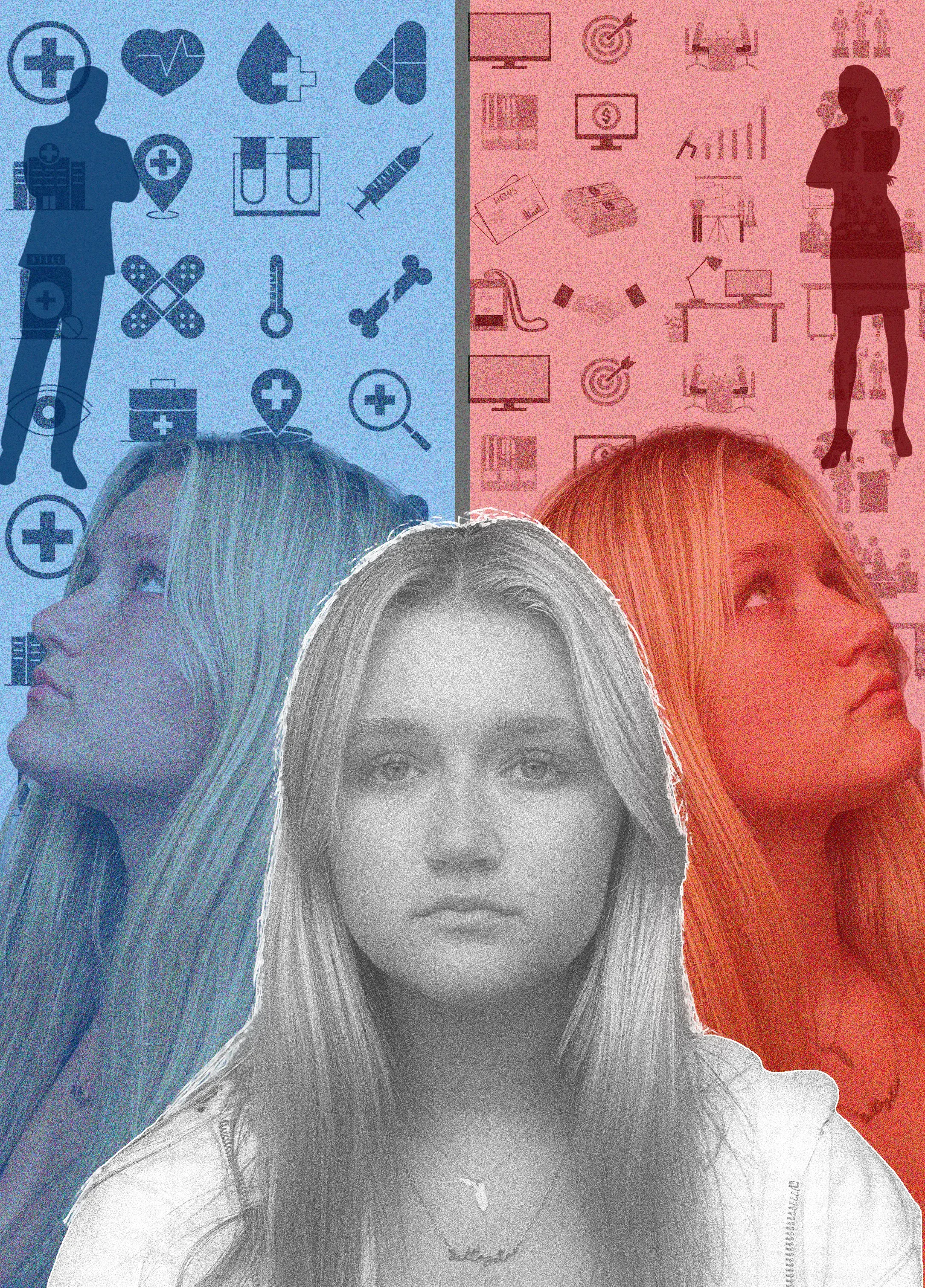
Split Decision is an autoscopy project that explores the internal conflict between identity and career pathing. By deconstructing and layering a self-portrait using professional editing software, this piece visualizes the psychological weight of diverse expectations and the personal struggle to define one's own future.
Project Specifications
Role: Digital Artist
Context: FMX 210: Digital Media | University of Tampa
Tech Stack: Adobe Photoshop, Adobe Illustrator, MacBook Air
Deliverable: Composite Digital Self-Portrait
Split Decision
The Vision: Mapping The Conflicted Self
The project was born from a prompt to transform a self-portrait into a representation of a deep-seated fear or persistent thought. I chose to portray the feeling of being pulled in opposite directions by family legacies while navigating the inherent stress of being a teenager tasked with deciding a lifelong career path.
Key Artistic Objectives:
Emotional Transparency: Using high-contrast black and white to emphasize the gravity and heaviness of the decision-making process.
Symbolic Layering: Implementing staggered outlines to represent the fracturing of identity under external pressure.
Conceptual Narrative: Using digital filters and generated backgrounds to symbolize the two distinct professional worlds vying for attention.
The Process: Advanced Image Manipulation
This project required a blend of technical precision and creative expression to move from a raw photograph to a conceptual art piece:
Portrait Deconstruction: I began with a raw self-portrait, stripping away color in Adobe Photoshop to focus on the raw, high-contrast emotion of the face.
Vector Augmentation: I used Adobe Illustrator to create sharp, geometric outlines that symbolize the "pull" of the two industries (Medicine and Business) and imported them back into the composite.
Filter & Background Integration: To represent the confusion of the choice, I generated background textures that mirrored the complexity of these career paths and applied object masking to isolate the portrait.
Compositional Balance: I layered these elements to ensure the staggering outlines felt heavy on the shoulders, visually communicating the weight of the decision I was soon to make.
Reflection: What I Learned
This project was incredibly personal because it gave me a way to express feelings I was not comfortable putting into words at the time. I learned that digital media is not just about making something look pleasing, but it’s a way to have a conversation with yourself. It was my first experience seeing how Adobe Photoshop and Illustrator could work together to create a profound, conceptual impact. It made me proud to see how a technical assignment could become a true representation of my life.
Looking Ahead: The Human Side of HCI
While this project was artistic, it directly influenced my current Honors Thesis research on user experience. It taught me that design can trigger strong emotions and that visual clarity, or the lack of it, affects how a person processes information. In the future, I want to explore how we can use these digital editing skills to create interfaces that better reflect the user's emotional state. My goal is to combine the technical rigor of my CS minor with the human-centered approach I developed in this autoscopy project.