
Note: Best viewed while imagining the viewer looking upward at a 12-foot ceiling installation with the volume turned up.
Postcard Heart
A Nine-Source Multimedia Projection Installation
“Postcard Heart” is a site-specific multimedia installation that explores the relationship between digital technology and global exploration. By projecting nine distinct video sources onto a customized ceiling grid, the piece reflects on how we travel through our devices, falling in love with distant landscapes through the glass of our screens.
Project Specifications
Role: Multimedia Artist & Technical Director
Context: FMX 463: Multimedia Installation | University of Tampa
Hardware: MacBook Air, 1,000 lumen Projector, physical masking materials
Technical Scope: 9 Projection Surfaces | 9 Synchronized Video Sources | Integrated Audio
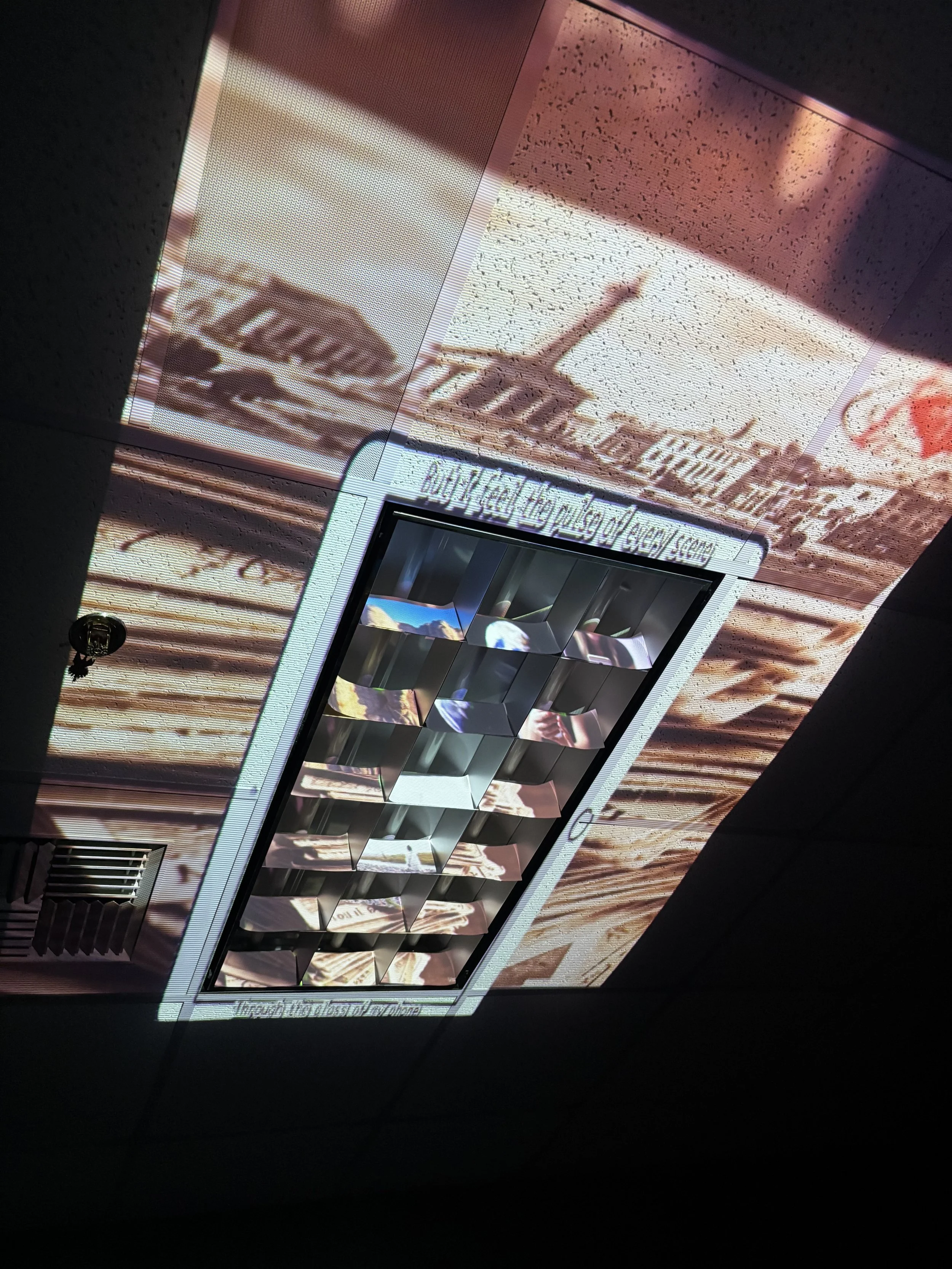
The Vision: Digital Wanderlust
The core concept explores a modern paradox: the desire to see the world vs. the reality of viewing it through a device. Using an original song created with Suno AI, the installation celebrates technology as a bridge that brings natural beauty to those who cannot travel, transforming a tablet screen into a portal for high-resolution memories.
Key Installation Objectives:
Spatial Mapping: Mapping nine unique video streams to fit precisely within a ceiling-mounted grid.
Physical Augmentation: Using white poster board on specific surfaces to optimize gain and image sharpness.
Mixed-Media Asset Creation: Combining curated online footage with custom Generative AI video to match specific lyrical prompts.
The Process: Multi-Platform Integration
This project required a complex workflow across several digital and physical platforms:
AI Audio Composition: I utilized Suno AI to compose a track that captured the emotional core of the piece, focusing on the theme of falling in love with places I’ve never been.
Visual Asset Sourcing & Generation: I bridged the gap between imagination and reality by using AI to generate specific scenes that didn’t exist online, ensuring the visuals perfectly matched the song’s narrative.
Physical Masking & Mapping: To create the iPad effect on the ceiling, I used white poster board to create high-contrast projection surfaces while allowing reflections off the surrounding glass to mimic the glow of a tablet screen.
Multi-Source Synchronization: I managed nine separate video sources to ensure a seamless, immersive experience where the lyrics and visuals were timed.
Reflection: What I Learned
This project was a huge challenge because it forced me to think about how art lives in a physical space, not just on a computer screen. Managing nine different sources meant I had to be extremely precise with my mapping and timing. I enjoyed using and exploring AI as a collaborator: It allowed me to create specific images I had in my head that I couldn’t have filmed myself. It really showed me that being a New Media artist means knowing how to pick the right tool for the right job, whether that is a piece of poster board or a complex AI prompt.
Looking Ahead: Immersive Storytelling
After working on this, I’m really interested in how projection mapping can be used in HCI to create more tangible interfaces. I want to explore how we can move digital content off our small phones and into the rooms we live in. My goal for the future is to study how these immersive environments can make technology feel more natural and less like something we are just staring at. I want to capture the magic of projection and find ways to make it functional in everyday life.