
Charlie Brown Dialogue Series
Exploring Narrative Performance Across 2D and 3D Dimensions
The Charlie Brown Dialogue series is a comparative study in character performance and technical animation. By using the same iconic audio clip across two distinct mediums, 2D and 3D, I explored the nuances of lip-syncing, facial expressions, and weight distribution. This dual-project approach allowed me to master two of the industry’s leading animation pipelines while maintaining a consistent creative vision.
Project Specifications
Role: Lead Animator & Character Designer
Context: FMX 238: 2D Animation I & FMX 217: 3D Animation I | University of Tampa
2D Tech Stack: Harmony, MacBook Air
3D Tech Stack: Maya, MacBook Air
Core Requirement: Precise dialogue matching with integrated secondary motion (snowflakes/clothing).

The Vision: A Seasonal Performance Study
Using Charlie Brown’s classic dialogue about snow, I aimed to create a seasonal revision of the character. The goal was to go beyond simple mouth movements and create a believable environment where the character’s physical actions, such as head turns and torso shifts, felt motivated by the spoken words.
Key Animation Objectives:
Lip-Sync Precision: Ensuring phonemes (mouth shapes) matched the dialogue perfectly in both vector-based 2D and rigged 3D environments.
Secondary Motion: Animating falling snowflakes and clothing details to add environmental "texture" and realism to the scene.
Dimensional Adaptation: Translating the simple, iconic 2D shapes of Charlie Brown into a 3D rig while preserving his recognizable silhouette and personality.
The Process: Translating 2D Logic to 3D Space
Working across Harmony and Maya required a shift in technical thinking while keeping the performance goals the same:
2D Narrative (Harmony): I focused on fluidity in 2D, hand-animating head turns and using layered snowflakes to create a sense of depth. I paid close attention to Charlie Brown's iconic outfit to ensure the brand identity remained intact.
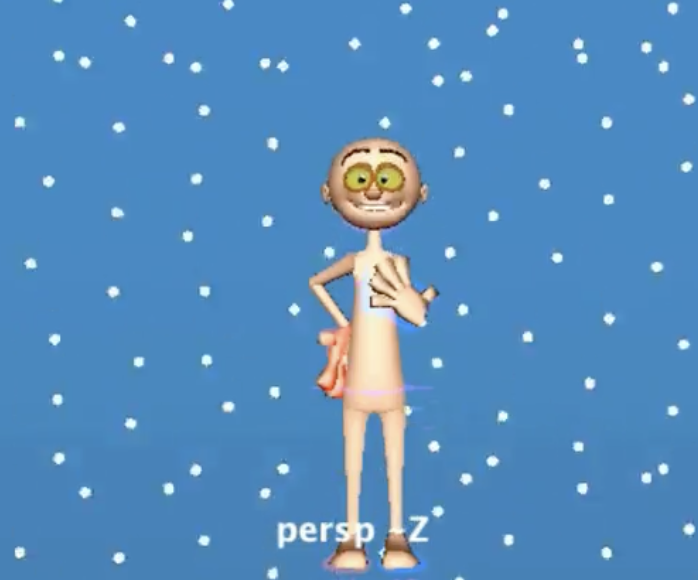
3D Performance (Maya): For the 3D version, I utilized a fully rigged character to explore more complex body mechanics. This allowed me to experiment with squash and stretch in the facial expressions to give the dialogue more emotional pop and believability.
Environmental Immersion: In both versions, I built custom backgrounds to place the character in a real environment. In Maya, I used 3D shapes to enhance the Christmas atmosphere and simulate snowfall around the character as he moved and spoke.
Action & Expression: I challenged myself to match the character's eye-darts and eyebrow raises to the inflection of the audio, ensuring the character felt alive and engaged with his thoughts.
Reflection: What I Learned
This was a fascinating project because it taught me that while the software changes, the rules of good animation stay the same. Managing the stress of many moving elements in 2D helped me be more organized when I moved into 3D. The biggest challenge was making Charlie Brown feel real in Maya without losing the simplicity that defines him. I loved seeing how the same piece of audio could result in two different, yet equally expressive, performances.
Looking Ahead: Character Interaction & Gaze
Completing these dialogue studies has directly influenced my Honors Thesis research on eye-tracking and digital engagement. I am interested in how viewers focus on a character's eyes versus their mouth during dialogue, and I plan to use my animation skills to build custom avatar tests for my study. In the future, I want to explore Facial Motion Capture (MoCap) and AI-driven lip-syncing to see how we can make digital characters react even more naturally to human interaction.